 By Braddy Carnige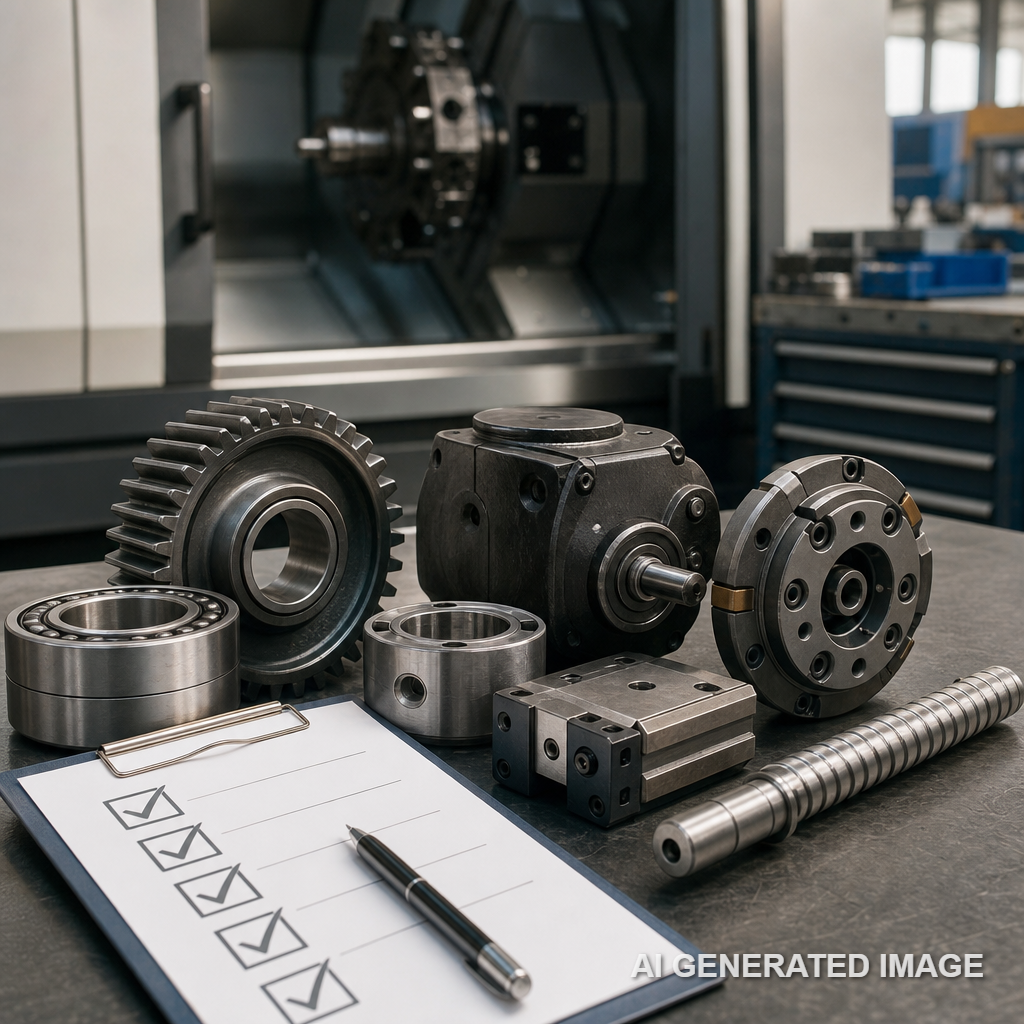
Buying machine tool spares involves more than matching a part number to an old invoice. Before ordering, check the environment the part will work in, the loads it carries, its exact dimensions and the records that keep the machine safe.
Key points
- Match the part to the machine’s real operating conditions, not just its part number.
- Confirm exact dimensions, fits and tolerances against machine drawings, not nominal size alone.
- Any change affecting torque, stopping or guarding needs a documented safety review before installation.
Check the environment and expected wear
Start with the conditions around the part. Cutting fluid, coolant, oil, dust, humidity, abrasive particles and cleaning chemicals can all change how materials behave. Contamination may reduce friction or accelerate wear, even when the replacement has the correct dimensions on paper.
Ask which material actually suits the application. Friction linings, seals, splines and other wear elements respond differently to heat, fluids and particles. A supplier should explain the intended operating environment rather than relying on a vague label like “industrial use”.
Next, identify the likely wear mode. Lining loss, spline wear, fretting, cracking and seal deterioration each call for different inspection points. A part with correct geometry may still have a shorter life if its material doesn’t suit the machine.
Duty cycle matters too. Establish whether the machine runs intermittently or continuously. In the UK, the Provision and Use of Work Equipment Regulations (PUWER) require work equipment to remain suitable for its intended use and safe condition, with inspection where deterioration could create risk. Equivalent obligations apply under national implementations of EU workplace equipment law elsewhere. Ask for replacement indicators and inspection criteria, not just an estimated service life.
Record these conditions before requesting a quotation. Clear operating information gives the supplier a practical basis for judging suitability, rather than guessing from a part number alone.
How machine tool spares handle load, speed and heat
Compare the machine’s normal torque, peak torque, rotational speed and duty cycle with the declared limits of the replacement. Average values can hide the real demand, since acceleration, emergency stopping and tool changes often create the highest loads.
Torque transmission deserves close attention. A clutch, coupling or brake can look similar while using different friction materials, spring characteristics, bore sizes or speed ratings. A change in stopping time or transmitted torque may quietly alter the machine’s risk profile.
Ask how the supplier established the thermal limits and request continuous and peak temperature figures, plus the testing conditions behind them. Repeated engagement can affect the friction coefficient, lubricant viscosity, seals, spring performance and nearby bearings.
A supplier listing machine tool spares should be able to provide operating limits that relate to the complete application, not just a product name. A catalogue entry alone can’t show whether a part suits the machine’s actual duty.
ISO 12100 places risk assessment and risk reduction at the centre of machinery safety and is referenced by both UK and EU machinery frameworks. If the replacement affects stopping, energy transmission, overspeed protection or guarding, document a review before installation. Treat the change as safety related, not as an automatic substitution.
Confirm dimensions, connections and technical records
Nominal diameter is only one measurement. Confirm the shaft diameter, bore tolerance, keyway or spline profile, mounting hole pattern, pilot diameter, axial space and direction of rotation, using measured values and machine drawings where possible.
ISO 286 provides a common system for tolerance classes and fits. Ask for the required fit, runout, alignment and installation tolerances, since a nominally correct part can fail early when misalignment or excessive runout transfers additional load into the assembly.
Actuated parts need extra checks. Verify voltage, current, connector type and control signal for electrical components; hydraulic and pneumatic items require confirmed pressure, port type and flow requirements. These details can decide whether the component operates safely at all.
Documentation should identify the part, revision or batch where relevant, and state installation requirements, operating limits, inspection criteria, material information and applicable test or conformity documents. For machinery placed on the EU market, the EU Blue Guide highlights traceability and instructions requirements; equivalent conformity and traceability rules apply for the UK market.
For machinery placed on the EU market, the EU Machinery Regulation 2023/1230, published in 2023, generally applies from 20 January 2027 and will replace the Machinery Directive framework for most new machinery. It does not directly apply to the UK, where a separate UK conformity regime continues to operate. Spare part decisions should preserve intended safety characteristics and available technical information under whichever framework applies to the machine.
Make the order easy to verify
Send the supplier the machine model, serial number, existing part number, photographs of interfaces and relevant operating data. Include drawings when available. This evidence helps distinguish revisions, regional variants and material changes that a shared part number may not reveal on its own.
Before approval, compare the written specification with the original machine documentation. Check every interface, limit and control requirement. If the replacement changes torque, stopping performance or guarding needs, record who reviewed the change and what conclusion they reached.
A short checklist prevents expensive assumptions. Confirm the environment, duty cycle, normal and peak loads, temperature, dimensions, fit, connections, documentation and supply conditions. Keep the quotation, drawing and installation instructions with the machine’s maintenance records.
Order with evidence, not appearance
Request measurements, operating limits and traceability details before placing the order. A part that fits physically may still fail under heat, load or contamination. The safest purchase preserves the machine’s intended function and leaves a clear record for the next inspection.